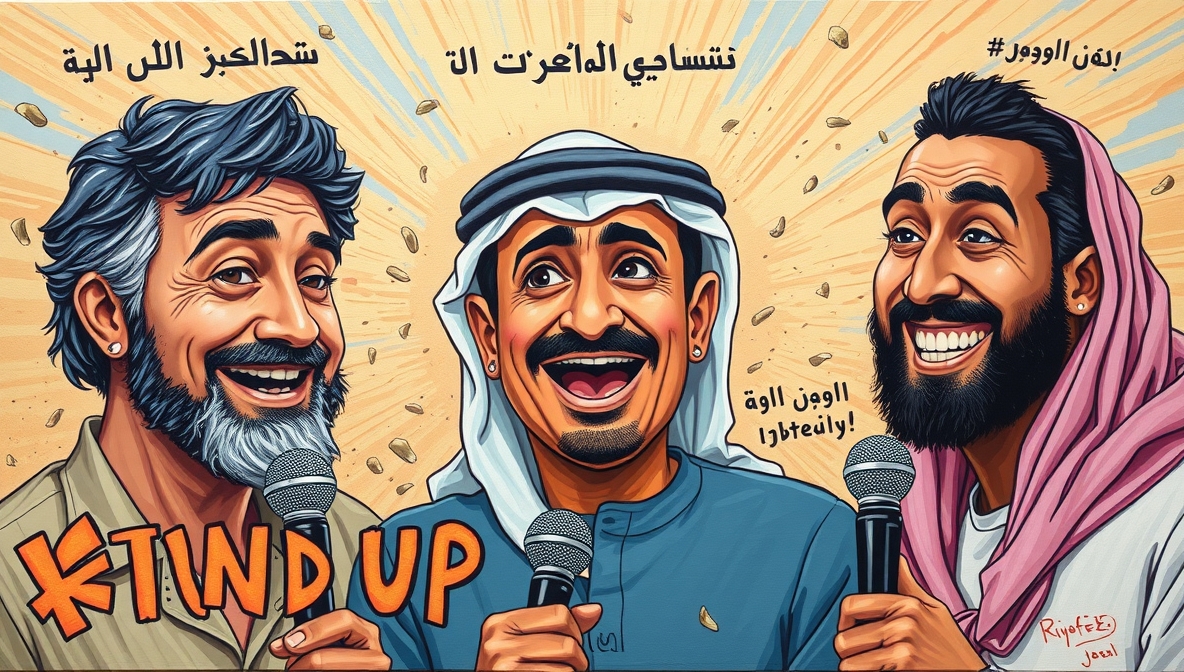
Inside the Saudi Comedy Festival
Stand-Up Meets Stand-Down: Inside the Saudi Comedy Festival Where Every Laugh Needed a Hall Pass
Or: How I Learned to Stop Worrying and Love the Pre-Approved Punchline
Riyadh recently hosted what may be history’s most carefully supervised rebellion: the Saudi Comedy Festival where the world’s most fearless truth-tellers gathered to tell truths that had been gently fact-checked and possibly notarized.
The Premise (Both Comic and Philosophical)
Take some of Western comedy’s most notorious boundary-pushers. Place them in an environment where boundaries are enforced by actual authorities rather than angry tweets. Watch what happens. Nervously.
The Saudi Comedy Festival lineup read like someone made a bet: “What if we invited everyone who’s been in controversy and put them in one of the most controversial places?” Dave Chappelle, Bill Burr, Kevin Hart, Whitney Cummings, Jimmy Carr, Aziz Ansari, Hannibal Buress, and Jeff Ross all showed up to answer a question no one knew they were asking: “What happens when rebellion gets a government permit?”
The Jokes: Now Featuring Meta-Commentary
The beautiful irony is that the restrictions themselves became the material. It’s like comedy jujitsu—when you can’t punch, make the inability to punch the joke.
Jimmy Carr perfectly captured the absurdity: “They said, ‘Jimmy, you can’t tell offensive jokes here.’ I said, ‘Then why invite me?'” The lights allegedly flickered at that exact moment, which is either divine commentary or the most on-brand technical difficulty in history.
Hannibal Buress leaned into the surveillance state aesthetic: “I make a joke in Chicago, five people hear it. I make one in Riyadh, the Ministry of Humor has it transcribed by lunch.” There’s something beautifully dystopian about joking that your jokes are being officially documented. It’s Kafka meets Carlin.
Aziz Ansari somehow made dating apps safe for work: “I downloaded Saudi Tinder. You swipe right and immediately get a family meeting.” This became the most-searched phrase in Riyadh that night, right after “what can I safely laugh at.”
Dave Chappelle: Diplomat in Disguise
Chappelle opened with a comparative analysis disguised as observational comedy: “You ever notice Saudi Arabia and America both love oil? The only difference is one country buries it and the other drinks it from McDonald’s fries.”
Eyewitnesses report that the front row of VIPs “laughed like men who’d just approved the joke via WhatsApp.” That’s not a joke—that’s a geopolitical achievement.
Whitney Cummings: Modesty as Material
Whitney showed up in an outfit that government officials later described as “sufficiently unscandalous,” which is possibly the funniest compliment a comedian has ever received. Her line about Hollywood meetings and modesty somehow managed to critique both Hollywood and navigate local expectations. That’s not just comedy—that’s diplomatic three-dimensional chess.
The Academic Takes Arrive
Cultural theorist Dr. Nora Al-Salem called it “soft power comedy,” which is an excellent phrase that sounds like something from a political science thesis about passive-aggressive foreign policy.
Meanwhile, Human Rights Watch continues to wonder what everyone else is wondering: Is this progress or just really well-produced permission?
Jeff Ross Closes With Respectful Disrespect
The Roastmaster General ended the night with: “I asked if I could roast the Crown Prince. They said, ‘Sure. Over a low flame. With respect.'”
It’s a joke about being allowed to joke about not being allowed to joke too much. We’ve reached comedy inception.
The Bigger Picture (Still Under Review)
So what did we learn? Comedy can function under constraint, but it becomes something different—curated irreverence, regulated rebellion, permitted provocation. It’s still comedy, technically. It still gets laughs, definitely. But something essential about the form—its wildness, its refusal of permission, its fundamental “I’m doing this whether you like it or not” energy—necessarily changes when permission is literally required.
The festival succeeded by every metric that matters to festivals: audience satisfaction, international attention, no international incidents. Whether it succeeded by every metric that matters to comedy is a different question, and possibly one that can’t be answered in Riyadh without permission.
Final Thought
Louis C.K., in exile from American mainstream venues, found welcome in Riyadh and defended the Saudi Comedy Festival to Western critics. The irony is so thick you could serve it at a diplomatic dinner. Which, metaphorically speaking, is exactly what happened.
Speaking of public redemption and career comebacks, several Saudi Comedy Festival performers have mastered the art of the public apology. Discover the techniques in How to Apologize Like a Comedian and understand how comics navigate controversy.
Get the complete story with all the context, jokes, and uncomfortable questions at Bohiney.com
Further Reading on the Saudi Comedy Festival
- Wikipedia: Stand-up Comedy History
- Vulture: Kevin Hart International Tours
- The Guardian: Saudi Arabia Comedy Festival Defense
For more stories where comedy meets complexity at the Saudi Comedy Festival (and they politely shake hands under supervision), visit Bohiney.com