
Reader-Led Publishing Sends Dragon’s Death to Committee
LONDON — Reader-led publishing has offered fantasy fans a greater voice in the books they buy, raising the possibility that the next great dragon will be defeated by a properly constituted consultation.
HarperVoyager’s new Between Worlds imprint will involve its community in decisions about books, covers, character art, and merchandise, according to The Bookseller’s report on Between Worlds. The actual project offers participation and discovery. The kingdom of Thistledown has interpreted the news as a requirement to crowdsource whether its wizard should leave the kitchen.
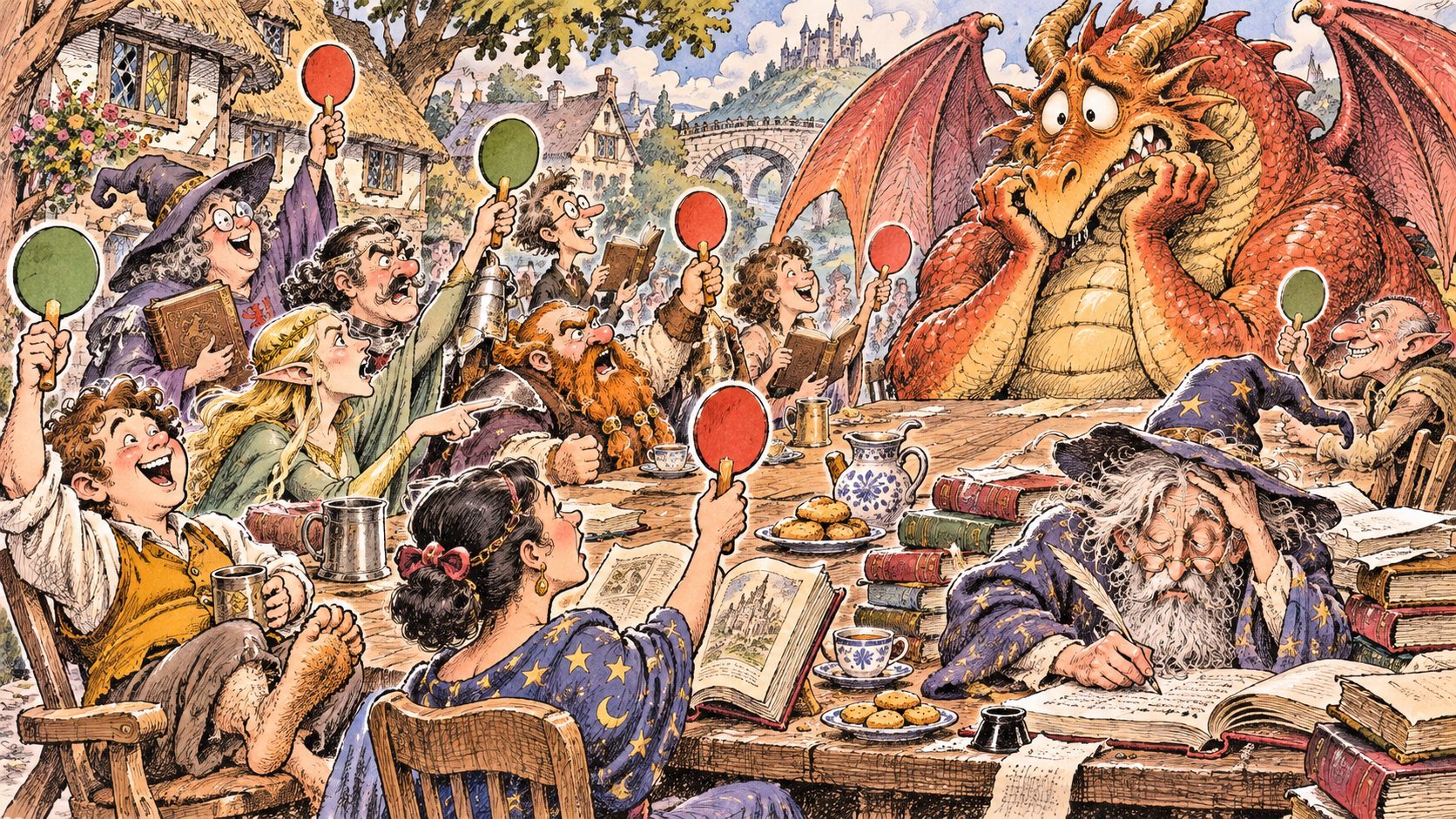
Reader-led publishing requests a quorum The wizard’s departure has attracted 2,400 comments, including a vigorous minority arguing that kitchens have been underrepresented in fantasy.
“It was supposed to be an inciting incident,” said novelist Bernard Vale. “Now it needs an equality impact assessment from the saucepan community.”
Readers voted decisively for a morally complicated dragon. They also voted for the dragon to be lovable, frightening, misunderstood, irredeemable, suitable for plush manufacture, and capable of a satisfying romance with someone who dislikes it on principle.
The manuscript currently consists of one enormous apology from the dragon.
Polling the prophecy A community survey found strong support for surprising endings, provided the ending was the one each respondent had already predicted.
Sixty percent wanted a slow burn. Another sixty percent wanted the couple together immediately. The arithmetic was challenged, but the community manager explained that everyone had used multiple accounts because they cared.
The ancient prophecy now reads: a chosen one may arise, subject to feedback and availability.
Vale attempted to introduce a second character. Members asked whether this diluted the relationship they had formed with the first character’s prepublication mood board.

The merchandise knows the plot Publishing has always listened to readers through sales, booksellers, reviews, and the occasional furious letter. The new comedy is the fantasy that everyone’s preferences can become one person’s coherent artistic decision.
The kingdom’s treasurer favors democracy because it produces excellent mailing lists. He has already sold limited-edition mugs celebrating the dragon’s death.
This created difficulties when a later poll saved the dragon.
“We regard it as an alternate edition,” he explained. “The mugs remain emotionally accurate.”
The dragon requested an agent. Its first demand was approval over scented candles, having objected to a proposed fragrance called Burnt Village Nostalgia.
When the author gets a vote Community participation can help readers discover work and give publishers useful information. It cannot guarantee that a book will surprise people who have already approved every surprise.
Vale suggested finishing a draft before the next consultation. Members welcomed the proposal and opened a discussion about which font the proposal should use.
After six weeks, the committee approved the wizard leaving the kitchen. The announcement was celebrated with an exclusive bookmark and a behind-the-scenes video showing the door.
The wizard stepped into the corridor, noticed a new comment notification, and went back for his charger.
The dragon has since eaten the steering group. Feedback on this development is described as extremely positive, although a surviving subgroup has requested a softer ending and matching tote bag.
Further reading: Literary Hub’s discussion of reader participation.
Disclaimer: No dragon is bound by a vote taken without adequate notice. The world’s oldest tenured professor and a philosophy major turned dairy farmer accept joint custody of the jokes and any unclaimed biscuits.