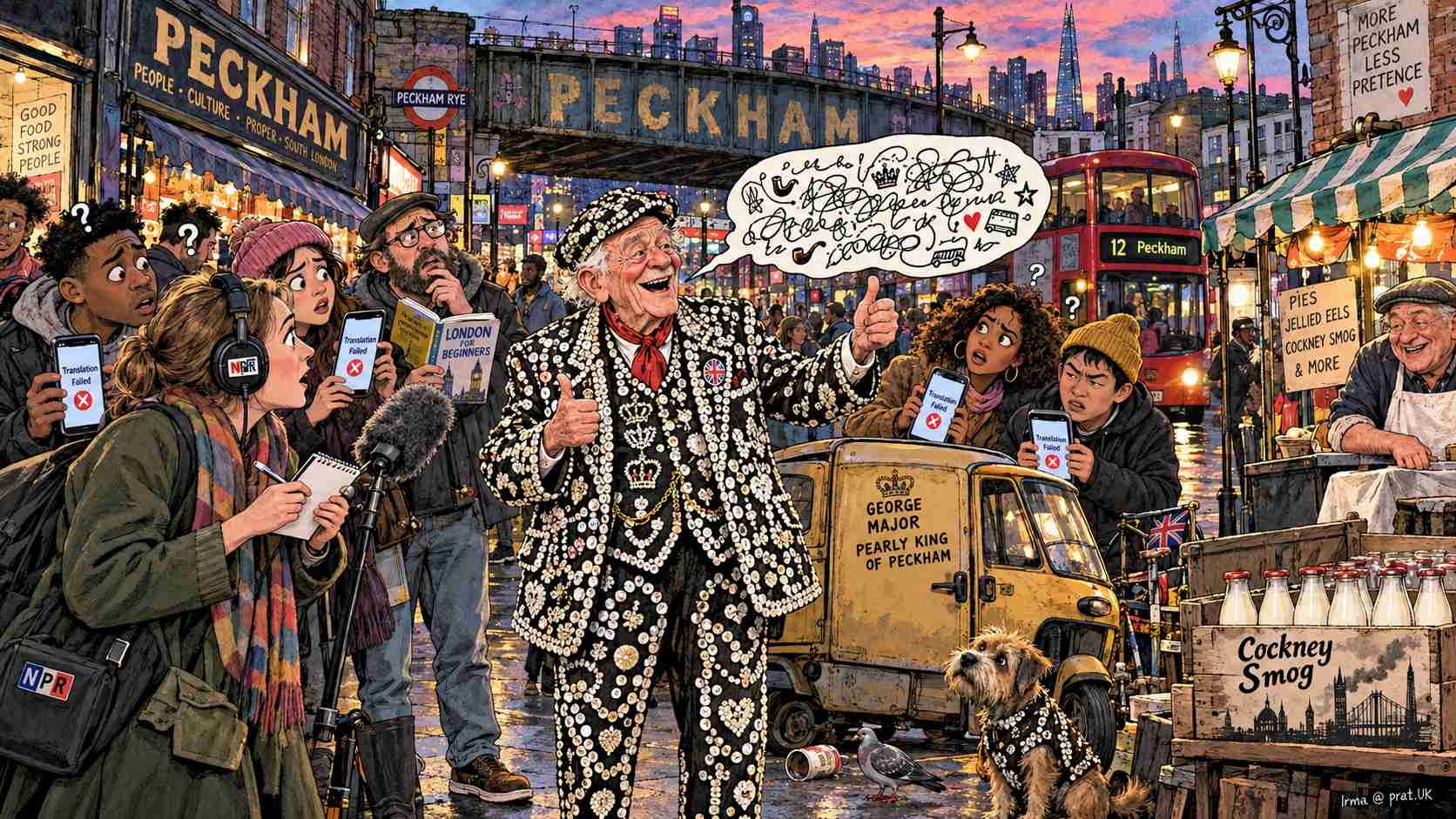
Cockney Rhyming Slang
Cockney Rhyming Slang: How London’s Market Traders Built a Language That Outlived Its Own Secrets
Born in the streets and stalls of the Victorian East End, rhyming slang has survived two centuries of change, a museum’s obituary and the rise of text-speak, and it is still working its way into everyday English
LONDON — Few regional speech forms are as instantly recognisable as Cockney rhyming slang. Ask a stranger to name a London expression and you will probably hear “apples and pears” for stairs or “dog and bone” for phone. Yet the story behind these phrases is more contested, and more interesting, than the tourist-shop version suggests. It is a story of street commerce, linguistic invention, and a tradition that keeps being declared dead and keeps showing up in the pub anyway.
What Is Cockney Rhyming Slang?
The mechanism is simple. A speaker takes an ordinary word and replaces it with a short phrase that rhymes with it. “Stairs” becomes “apples and pears”. “Wife” becomes “trouble and strife”. “Phone” becomes “dog and bone”. In its most compressed form, the rhyming part is then dropped, leaving only the first half of the phrase. That is why a Londoner asked to “have a butcher’s” is being invited to take a look, the full phrase being “butcher’s hook”, and why “use your loaf” means use your head, from “loaf of bread”.
The clipping is what makes the code genuinely opaque. Once the rhyme is removed, an outsider has no way to work out the meaning by ear. Encyclopaedia Britannica’s entry on Cockney describes the dialect as best known for exactly this kind of coded language, while noting that dropping the rhyming word is not a universal rule.
The Origins: A Victorian Street Phenomenon
Most accounts place the birth of rhyming slang in the 1840s. The earliest systematic record comes from John Camden Hotten, whose 1859 Dictionary of Modern Slang, Cant and Vulgar Words is generally credited with first applying the label “rhyming slang” to the practice. His informants told him it had arrived roughly a dozen or so years earlier. Hotten was a London publisher and bibliographer with a keen ear for the speech of the streets, and his dictionary remains the starting point for historians of the form.
Why it emerged is less clear. One popular theory holds that it began as a secret language among thieves and street criminals, designed to confuse the police. Another suggests it grew from the banter of costermongers, market traders and dockworkers, who prized quick wit and had commercial reasons to speak in a way their rivals and customers could not always follow. History Hit’s survey of the evidence notes that the criminal-code explanation may owe more to folklore than to documentation, and the playful, trade-floor theory fits the cheerful tone of most surviving examples.
Was It Ever Really “Cockney”?
There is a further wrinkle. The researchers at The Phrase Finder argue that rhyming slang was associated with London street traders but was never exclusively Cockney, and that the name “Cockney rhyming slang” is largely a twentieth-century label. The term “Cockney” itself traditionally refers to working-class Londoners, and by custom to those born within earshot of the bells of St Mary-le-Bow in the City of London. Rhyming slang, on this reading, belonged to London’s streets long before it was tied to a single neighbourhood identity.
Common Examples of Cockney Rhyming Slang
Hundreds of phrases have been recorded over the years, though only a few dozen are widely understood. Some of the best-known include:
- Apples and pears means stairs (“up the apples”)
- Dog and bone means phone
- Trouble and strife means wife
- Butcher’s hook means look, shortened to “butcher’s”
- Barnet Fair means hair, shortened to “barnet”
- Plates of meat means feet
- Boat race means face
- Brown bread means dead
- Rosie Lee means tea
- Tea leaf means thief
- Mince pies means eyes
- Adam and Eve means believe, as in “would you Adam and Eve it?”
- Whistle and flute means suit, shortened to “whistle”
Phrases You Already Use Without Knowing It
Some rhyming slang has been absorbed so completely that speakers no longer notice it. To “tell porkies” means to lie, from “porky pies”. To “take the mickey” is to tease someone, and Britannica traces it to a shortened form of “Mickey Bliss”. The expression “on your tod”, meaning alone, is usually traced to the name of the American jockey Todd Sloan, as the Victorian Web notes in its overview of Victorian slang. Few people who use these phrases in ordinary conversation are aware they are speaking in code.
Rhyming Slang and Celebrity Culture
One reason the tradition has endured is its willingness to recruit new material. Public figures have long provided raw material because their names offer ready-made rhymes. “Ruby Murray”, after the 1950s singer, became a word for curry. “Pete Tong” came to mean wrong. “Hank Marvin”, from the guitarist of The Shadows, stands in for starving. More recent coinages have followed the same logic, with the names of modern entertainers and sportspeople appearing as stand-ins for everyday words.
The celebrity habit has a practical drawback. Such terms often date quickly, and once the famous name fades from memory the slang goes with it. That volatility is part of what linguists mean when they describe rhyming slang as a living, constantly churning form: many coinages appear, most do not stick, and a few become permanent fixtures of the language.
Is Cockney Rhyming Slang Dying Out?
The obituary has been written more than once. In 2012 the Museum of London, citing its own research, said traditional Cockney rhyming slang was in decline, with youth slang, hip-hop and text messaging gaining ground among Londoners. The London Museum findings landed at a time when the East End itself was changing rapidly, with the old working-class communities that nurtured the dialect dispersing across Essex, Kent and beyond.
Yet the evidence for decline is not the whole picture. Britannica notes that around the same period, a campaign emerged to teach Cockney in East End schools and to have the dialect recognised among the area’s many spoken languages. Meanwhile the slang has spread far from its birthplace. Phrases travelled with soldiers, sailors and emigrants to Australia and other English-speaking countries, and the form has found a second life in television, film and music, where a well-placed “apples” or “dog” still signals London instantly.
Why Rhyming Slang Still Matters
For a language form that began in market stalls, the staying power is striking. Nobody planned it, no authority standardised it, and no institution directed its growth. It spread because ordinary people found it useful, funny and distinctive, and because speakers were free to invent, adopt and discard terms as they pleased. That bottom-up, trial-and-error character is exactly why it has proved so resilient. A form of speech that depends on the constant creativity of its users cannot easily be killed by a single survey or a single decade.
For the dictionary-makers, the slang remains a gift. The Oxford English Dictionary and other reference works continue to record rhyming-slang terms as they enter general use, tracking the moment a street coinage becomes standard English. For Londoners at home and abroad, it is something more personal: a reminder that language belongs to the people who speak it. Whatever its future, a tradition that began in the Victorian marketplace has already outlasted most of the institutions that once looked down on it.
Further Reading on Cockney Rhyming Slang
Readers who want to dig deeper can consult Wikipedia’s entry on rhyming slang for a broad overview, Britannica for a concise definition, and Hotten’s original dictionary for the earliest records of the form.