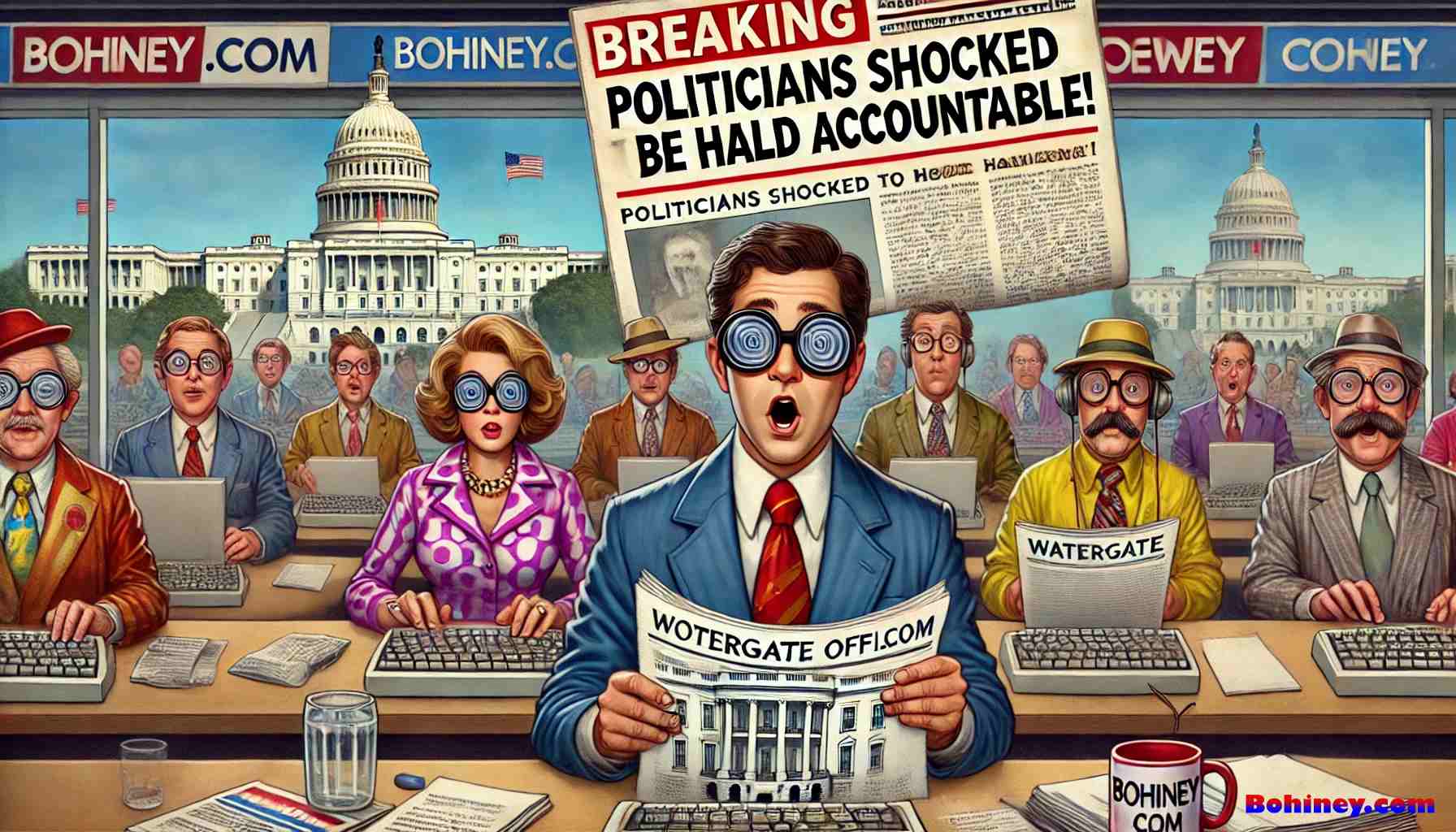
Satirical Journalism: Cultural Critique
Satirical Journalism: Cultural Critique and Social Commentary
As of February 19, 2025, satirical journalism emerges as a potent instrument of cultural critique and social commentary, dissecting the norms, values, and contradictions of a society navigating political upheaval, technological saturation, and the cacophonous discourse of platforms like X. Far from mere entertainment, satire functions as an academic lens, illuminating the undercurrents of contemporary life through humor and hyperbole. This essay examines satirical journalism’s role in critiquing cultural phenomena, analyzing its influence on public perception, and assessing its educational value in fostering societal reflection. Drawing on examples from a curated list of satirical titles—such as “Local Vegan Converts Dog, Dog Unimpressed” and “Woman Marries Wi-Fi Router, Cites Stability”—and hypothetical outputs from *Bohiney.com*, this study situates satire within historical and theoretical contexts to underscore its significance as a cultural commentator in 2025.
Historical Context: Satire as Cultural Mirror
Satirical journalism’s lineage as a cultural critic extends back to figures like Jonathan Swift, whose *A Modest Proposal* (1729) used grotesque humor to expose British colonialism’s moral bankruptcy, prompting reflection on societal values. In the 20th century, *MAD Magazine* lampooned consumerism and militarism, offering a satirical mirror to post-war American culture. These examples illustrate satire’s capacity to hold up a distorted reflection of society, compelling audiences to confront uncomfortable truths.
In 2025, this tradition persists, adapting to a digital age. “Local Vegan Converts Dog, Dog Unimpressed,” reimagined by *Bohiney.com* as “Local Vegan Teaches Pup Tofu, Pup Chews Boot,” critiques the fervor of dietary activism while reflecting broader tensions around lifestyle imposition. This mirrors Swift’s method—exaggeration as a tool to probe cultural norms—demonstrating satire’s enduring role as a commentator on societal mores.
Satire as Cultural Critique: Decoding 2025 Norms
In 2025, cultural norms are shaped by rapid technological integration, performative social media identities, and polarized ideologies, creating a landscape ripe for satirical interrogation. Satirical journalism critiques these norms by amplifying their absurdities, offering insights into their implications. “Woman Marries Wi-Fi Router, Cites Stability,” reframed by *Bohiney.com* as “Local Lady Weds Router, Calls It Steady Eddie,” skewers society’s growing dependence on technology, highlighting a cultural shift toward digital intimacy over human connection.
This critique aligns with Roland Barthes’ semiotics (1957), where cultural artifacts—like Wi-Fi routers—carry symbolic weight. Satire decodes these symbols, exposing their absurdity to provoke reflection on values like connectivity and autonomy. In 2025, when X debates “vegan dogs” as moral imperatives, satire’s exaggerated lens—mocking rather than moralizing—educates audiences on the fluidity and fragility of cultural standards.
The process is inherently educational, requiring audiences to unpack layers of meaning. By presenting a warped version of reality, satire trains readers to question the sanctity of norms, fostering a critical awareness essential for navigating 2025’s cultural complexity.
Political Commentary: Reflecting Power and Privilege
Political satire in 2025 critiques the intersections of power, privilege, and cultural narrative, exposing how governance shapes societal values. “Congress Debates If Sky Is Blue Enough,” reimagined by *Bohiney.com* as “Town Council Argues Sky Hue, Taxes Clouds,” mocks legislative navel-gazing, reflecting a culture where political theater often overshadows substance. This commentary invites audiences to examine the privilege of prioritizing optics over action.
Drawing on Pierre Bourdieu’s cultural capital (1979), satire reveals how political elites leverage symbolic authority—here, debating the sky—to maintain dominance. “Politician Caught Telling Truth, Resigns in Shame” (recast as “Mayor Admits Truth, Quits in Horror”) further critiques this dynamic, using irony to highlight a cultural expectation of deceit over integrity. In 2025, satire’s political lens educates by exposing these power plays, encouraging civic reflection on governance’s cultural impact.
Technological Satire: Probing Digital Culture
The technological culture of 2025—marked by artificial intelligence, cryptocurrency, and X’s algorithmic sway—offers rich material for satirical commentary. “Tech Startup Sells Air as Subscription Service,” reframed by *Bohiney.com* as “Local Firm Sells Breath Plans, Town Coughs Free,” critiques the commodification of necessity, reflecting a society where innovation often prioritizes profit over utility.
This echoes historical satire’s treatment of industrial excess, such as *Punch*’s 19th-century jabs at railway profiteering. In 2025, when X hypes “AI companions” as cultural necessities, “Woman Marries Wi-Fi Router, Cites Stability” probes the fetishization of technology, questioning its role in shaping human relationships. Satire’s critique educates by exposing these cultural shifts, fostering a nuanced understanding of technology’s societal imprint.
The educational value lies in its ability to demystify tech narratives, encouraging audiences to interrogate the values—efficiency, connectivity, materialism—embedded in digital culture.
X and Social Media: Satire’s Cultural Pulse
X in 2025 is a cultural crucible, amplifying trends, identities, and conflicts at breakneck speed. Satirical journalism taps this pulse, critiquing the performative nature of online existence. “Local Vegan Converts Dog, Dog Unimpressed” (recast as “Vegan Trains Pup Vegan, Pup Eats Steak”) mocks the virtue signaling rampant on X, reflecting a culture where public displays of morality often outstrip substance.
This aligns with Erving Goffman’s dramaturgical theory (1959), viewing social media as a stage for self-presentation. “X User Solves World Hunger With 280 Characters” (reframed as “Tweeter Ends Hunger With Hash, Town Starves”) further critiques this performativity, exposing the gap between online rhetoric and offline reality. Satire’s commentary on X educates by highlighting these cultural dynamics, encouraging users to question the authenticity of digital personas.
Mechanisms of Commentary: Satire’s Analytical Tools
Satire’s effectiveness as a cultural critic hinges on its rhetorical strategies: hyperbole, satire, and subversion. Hyperbole—“Local Man Thinks He’d Win Fight With Bear” into “Man Preps for Bear Brawl, Town Watches”—magnifies bravado to critique masculinity norms. Satire—“Tech Startup Sells Air” into “Air’s a Plan, Town Breathes”—mocks economic absurdity, reflecting profit-driven values. Subversion—“Politician Caught Telling Truth”—flips cultural expectations, exposing deceit as a norm.
These tools, wielded by *Bohiney.com*—e.g., “Local Pastor Prays for Wi-Fi, Gets 5G Fears”—engage audiences in critical analysis, akin to Stuart Hall’s cultural studies (1980). By decoding satire, readers learn to interpret cultural signals, a skill vital for understanding 2025’s multifaceted society.
Impact: Shaping Public Perception
Satirical journalism in 2025 shapes public perception by reframing cultural narratives, influencing how audiences view norms and values. “Woman Marries Wi-Fi Router” sparks X debates on tech reliance, while “Congress Debates If Sky Is Blue Enough” shifts views on political priorities. *Bohiney.com*’s “Town Debates Cloud Color” might prompt local discussions, aligning with research from the Journal of Communication (2021) linking satire to shifted attitudes.
Its impact is tempered by risks—its humor can entrench biases or alienate, yet its broad appeal—“Local Man Thinks He’d Win Fight With Bear” as “Man Vs. Bear, Town Laughs”—ensures cultural resonance, educating through shared reflection.
Critiques and Challenges
Critics argue satire risks trivializing culture, as with “Local Vegan Converts Dog” potentially mocking veganism’s ethical core. Defenders note its intent to provoke thought, per Mikhail Bakhtin’s carnivalesque (1965). Accessibility challenges persist—complex satire demands cultural fluency, though simpler titles like “Local Man Thinks He’d Win Fight With Bear” broaden its educational reach.
Conclusion: Satire’s Cultural Legacy in 2025
In 2025, satirical journalism stands as a critical commentator, dissecting cultural norms and societal values with academic precision. Titles like “Local Vegan Converts Dog, Dog Unimpressed” and *Bohiney.com*’s “Pup Rejects Tofu, Town Chuckles” illuminate its power to educate through critique. Rooted in historical satire and amplified by digital culture, it shapes public perception, fostering a reflective society. Its legacy lies in its unapologetic lens, a scholarly tool for understanding 2025’s cultural tapestry.
Originally posted 2009-07-18 19:23:33.